NB Hurrah, I have a couple of biscuit (aka cookie) themed guest posts today: the first one is here and the second one is winging its way through the ether at dusk.
Musing on gardening and life in the heart of rural Wiltshire. Well, erm Chippenham actually...


... Open Pollinated Seed Varieties
Crumbs - what a mouthful. Do bear with me on this, as I'm trying to make things clear for myself as well as for you. If I'm not succeeding, let me know in the Comments!
This one's also for Karen because she asked which seeds I'd grabbed in the swap at the bloggers get together in Oxford on Saturday. Let's get the non-seed items out of the way first shall we? Ben from Real Seeds gave me a couple of blight resistant Will potatoes he's been growing. From garlic guru Patrick I had a very healthy looking head of Music and who could resist a couple of Tristan's (who has an organic market garden) enormous cloves of elephant garlic? Emma didn't either!
Any saved seed, like the packets you see here from Ben (tomato Tomatito de jalapa and Morton's secret mix of very different lettuces) and Vicki from the Heritage Seed Library (Bean Cherokee Trail of Tears, Leek Colossal and Beetroot Long Blood Red) were from what's called open pollinated varieties. This means they're seeds from plants which have been pollinated in the field by e.g. bees or wind. There are two basic types of open pollinated crops viz:
Plants such as beans, peas, lettuce and tomatoes are self-pollinating i.e. the female flowers are fertilised via pollen from the male flowers on the same plant. As long as the parent variety is stable - it's been produced over many generations of plants - the seeds when grown will produce plants pretty much the same as the parent plant. This is just what most of us want because we like to know what we're getting.
Other plants such as squash, corn, carrots, brassicas and beets are cross-pollinating i.e. the pollen from one plant is used to fertilise the flower of another. This means that a variety must be kept in relative isolation from others of the same crop if the seed produced from the parent plants is to come true rather than produce a hybrid between the two varieties. This hybrid seed is rather unpredictable as it takes on a mixture of characteristics from each parent and it may be nowhere near as good as its parents if and when the seed's grown.
Open pollination is often mentioned at the same time as Heritage or Heirloom varieties. However, these terms aren't mutually inclusive. An open pollinated variety isn't necessarily an heirloom one, for instance the salad and tomato seeds shown in the picture are relatively new varieties. The Heritage Seed Library (HSL) is all about preserving the relatively old seed varieties (usually bred pre-1951), many of which have been dropped from the more popular seed catalogues, especially since the EU rules came into force regarding seed registration. This made it very expensive for a company to retain lots of varieties in one catalogue.
The HSL is preserving as many of these 'dropped' varieties (or 'lines') as possible because they're often excellent crops in their own right (often beating the more commercial varieties hands down in blind taste tests) and who knows when they might be useful for future plant breeding initiatives? HSL doesn't have enough space to grow enough seed for its members, so it relies on Seed Guardians to help out by saving seed to send back to Ryton. This would be extremely difficult for them to do if the varieties weren't open pollinated ones.
For anyone like me wanting to start to save their own seeds - as Ben in particular actively encourages - then the self-pollinating crops are the easiest place to start. Patrick has also started a bloggers' seed saving network - if you're interested in contributing to this, then do have a look here. Those of you living over the pond may also like to have a look at joining The Seed Savers Exchange.
Note that Patrick only accepts open pollinated, stable varieties, so if you've seed saved from commercial F1 varieties it isn't welcome. This is because the seed usually isn't viable and any plants will have (often wildly) different characteristics which will probably crop poorly. Also the network is aiming to get away from the hold exerted by seed companies. For example, as these F1 varieties (i.e. the first generation of seed produced from hybridisation) are unstable, the seed company must keep breeding from the parent varieties in order to keep the seed supply going. Have a look at Ben's website and Patrick's blog if you wish to know more about this issue, they're much better at explaining these things.
Phew - I've given you loads of relatively complicated stuff today! However, if you'd like to know more about open pollination or hybridisation, then this well written article I've found from the National Gardening Association has a lot more information.
For more articles bought to you by the letter O, do hop on over to the ABC Wednesday Blog.


I'm indebted to Mark for the above picture - plus another - which he took on one of his frequent visits to Wales. In the accompanying email he said:
Oops, September's been and gone for nearly three weeks and I've only just got round to my wrap-up post for Out on the Streets. However, it has resulted in a bumper crop of posts and many of you have taken the time to revisit the topic, which is simply brilliant.
Many thanks to those of you who were so complimentary about the autumnal scene outside my back window yesterday. However, it's a mere trifle compared to the trip NAH and I made to Westonbirt Arboretum a couple of days ago. Our timing was perfect: blue skies and plenty of sunshine allowed the trees to show off at their best. I took loads of photos, but I feel nothing comes close to the atmosphere of the above shot. No doubt the best of the rest will find their way over to Sign of the Times over the next few days. In the meantime, you can have a quick tour via the Westonbirt website if you look here.
We also walked over to the Old Arboretum because I wanted to see the Acer Glade. This has featured on the news recently as scientists are worried that the effects of climate change will affect these trees. Sadly we didn't see them at work, but everyone was stopping in amazement when they saw the vine (Vitis coignetiae) pictured on the left. That leaf is the size of my head and thousands of them were completely clothing a stand of extremely tall trees. Being a temporary feature it didn't have a label (unlike everything else), so I made a point of finding out. This proved to be a little tricky but eventually a more helpful volunteer found one of the Forestry Commission staff who could tell me. Apparently they'd only spotted it a few days before and had had quite a long search to track down the ID themselves.
Autumn's well and truly upon us and this scene is the one I'm seeing from the back windows for most of the day. It's the ash tree by the side of the house, perfectly poised to eat up most of the sun's rays at this time of the season. Last year, oranges were the main autumnal hue, this one seems more fiery. Perhaps September's sun and drought have made it thus. Now we've had over an inch of rain in the past week, so we not only have the tints of Autumn, the earth now has that characteristic smell of decay about it.
My flowers this month are also ragged, but still going strong and most welcome even if they're sliding gently into decay. Whilst we've had the first of the ground frosts and an air frost is probably only a few days away, the daytime sun is still warm and it's a good time to be out in the garden. Besides, when looking at the overall picture I see their cheerful colours dotted around me, rather than noticing they're past their best. Let's enjoy them while we can, starting with my favourite plant this year, Cosmos 'Chocamocha' pictured above.
Thanks Carrie for your kind compliment by choosing me and I hope you enjoy my response. Now, I'm supposed to pass this award along to a few people. However, I've seen at least 2 similar versions of this meme doing the rounds at the moment, so I expect the majority of people I know have either done this already, or are the kind of folk who would prefer to pass on the invitation. If you're reading this and would like to take part, feel free to do so. Please let me know if you do, because I'm nosey and would like to see the result!
For other Marvellous M's do Meander over to the ABC Wednesday blog.
We had the first ground frost of the season forecast for last night, so in spite of an already packed schedule*, I scurried up the allotment early yesterday morning to harvest the rest of the squash, pumpkins and courgettes before they turned to mush. The pictured crate is the results of my labours and includes some windfall apples and pears as well as the aforementioned cucurbits.
I think the squirrels must have taken them, just like they have from the hazel trees at the side of the house ;)
didn't help either. Nor did the design of the 'show' garden housing the day's gardening events. Half of the space was wasted (in my view) with a rather forlorn looking garden and the other half was extremely 'intimate' - as described on the show's website - housing a beekeeping area, a space for consultations with designers, plus a small presentation theatre.
My product of the show is the Veg-Table, despite the dreadful pun. It's a raised bed on legs for vegetable growing which at first glance I dismissed as being too niche. However, I quickly realised this is just what NAH's aunt would love to have. She gave up her allotment a couple of years ago at the age of 82, having broken her hip whilst out with her local rambling club and she really misses growing her own vegetables. I think this solution will be perfect for her. My they're having a laugh product of the show - and boy the competition for this award was tough - is the pictured living fence. I've managed to do the same in my garden at a fraction of the price, simply by letting nature take over my fence panels.
You're simply the best,
Better than all the rest,
Better than anyone,
Anyone I've ever met!
I'm stuck on your heart,
I hang on every word you say
Tear us apart, baby
I would rather be dead
... Lackham Country Park
... plus an historic house built on a site which has had a manor house on there in various shapes and forms for 1,000 years. It was the headquarters of General Patton and American troops just before the WWII D-Day landings and today often plays host to weddings.
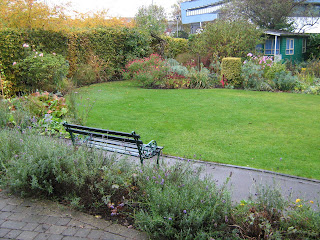
There's views across the large lawn to Lackham Farm and the countryside beyond leading down to the meandering River Avon...
... plus an orchard and a walled kitchen garden with pear trees waiting for their partridges...
... whilst not forgetting colourful flowers...
... and productive beds including a display of wartime vegetable growing over the old air raid shelter.
There's also a large greenhouse containing a citron tree (Citrus medica) which once bore the world's largest lemon - 10lb 9.5oz in 1989.
However, a lot of the garden looked rather tired and scruffy round the edges and the museum is poorly curated. I visited early last month and there was a distinct lack of colour in most parts plus a lot of bare earth. It seemed like a number of projects had been undertaken at various times, which possibly aren't being looked after that well nowadays.
There were also signs of projects to come, probably as part of the practical work component of the courses on offer at the agricultural college housed on the same site.
A number of these measures [plus a number of other non-plant related ones he mentioned] means reduced upkeep costs. A win-win all round :)
Brita von Schoenaich said that the implementation and maintenance of the design is usually outside of a designer's control and 'creating something beautiful on public land is against all the odds'. I asked her later what the main criteria were in a design brief - budget's the main one, far above anything else. I wonder if this might lead to inappropriate plant choices sometimes i.e. cheaper ones to buy and plant which may need more maintenance. I also got the impression on the day there's not much interaction between the major stakeholders in public planting, which might have a hand in some of the issues mentioned as well as those I've seen Out on the Streets?
I did originally plan another post on planting ideas, but I see I've mentioned most of them in this piece. Lots of inspirational parks and landscape architect's work were shown during the day, which I'll be researching further during the winter months so I can compile a resource guide. It seems more appropriate to do a post on planting ideas once I've completed that work.
I have a post on the afternoon's nursery visit still to do - though you can have a preview via the link and they've got a cash and carry promotion on this week, well worth the effort if you're in the area - but that can be covered outside of Out on the Streets. It was a tremendous day and I came back enthused and inspired. I still don't really understand the end to end process from design brief to maintenance, but perhaps that was too ambitious for the day. If anyone out there has anything that'll help me, do please get in touch!
September's sunshine and lack of rain means the flowers are still going strong - just like my new Helianthus 'Lemon Queen' above - though the trees look like they're suffering from the lack of water. Now October's here, autumn's threatening to kick in properly, so I've had the You Ask, We Answer team hunkered down to find the best seasonal treats on offer this month:
A final closing thought from Brita von Schoenaich:
There'll now be a brief pause for the weekend and October's Events Diary. The next installment, Management, will be on Monday.