I need you to use your imaginations today and substitute the Antarctic Ice Sheet in the above diagram (courtesy of Hannes Grobe and available for use under Creative Commons Licence via Wikimedia) for the 1 in 10 slope in my garden and the ocean/sea ice to the left for the bottom of the slope complete with fence and hedge. If you do that, you now have the classic conditions for katabatic winds forming in a garden setting, more commonly known as a frost pocket or frost hollow.
As you can see from the diagram, katabatic winds are formed when cold air meets warmer air and the resultant difference in pressure between the two, aided by the downward pressure of gravity forces the cold air down the slope. As well as the Antarctic and my garden, these winds are commonly found in mountain areas and many other places where these kind of conditions occur.
Whilst you're probably not familiar with the name katabatic (from the Greek kata, meaning down) you might know some of the special, regional names given to this type of wind. There's the Bora, a northeasterly wind which blows across the northern Adriatic and the Mistral, a northerly which travels across the French Mediterranean coast in winter. We've experienced the latter on sailing and windsurfing holidays in the Mediterranean and NAH owns an Equipe, a racing windsurfing board made by the Mistral company. The speeds of these winds can be high: the Bora can reach over 100 miles an hour and they often exceed 120 miles an hour in the Antarctic.
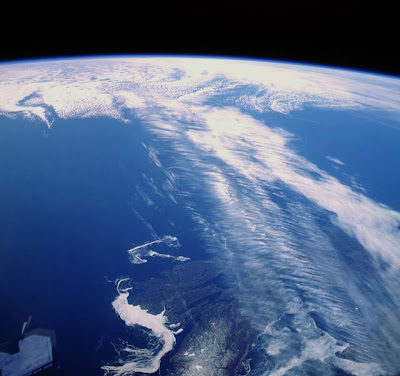
It's usually difficult to see these kinds of winds, but I did find a rather beautiful example of it in action in the Antarctic to show you courtesy of Samuel Blanc, again under Creative Commons Licence and via Wikimedia. I also found a rather beautiful description of them (complete with diagram showing how they form in mountain areas) from a sailor's viewpoint.
Here in my garden any katabatic winds I get are very much gentler breezes and often go unnoticed as is the case with anywhere where frost pockets or hollows occur. The terrain isn't as dramatic or as high as that found in the Antarctic or mountainside, nor is the difference in temperature between the warmer and colder air. After all, frost does tend to form in relatively calm conditions.
However, the effects of my relatively minor katabatic wind does mean I have to be careful with my choice of plants for the bed at the bottom of my garden. They need to be much tougher than those I can grow as the top which also has the protection of the house and warming effects of the patio and garden walls. In an ideal world I should get rid of the hedge and fence completely as they're allowing the cold air to collect at the bottom of my garden.
Failing that, I should replace them with something that would allow the air to flow through the barrier. However, this is the boundary to my garden and to replace or remove them would leave us vulnerable to vandalism or burglary. So they'll have to stay and I'll choose my plants for there accordingly. Luckily my garden's south facing and in the southern half of Britain, so the days when my garden is truly a frost pocket are thankfully rare.
How's the weather with you today? Having come in like a lamb, the last day of March is living up to the rest of the saying and roaring out like a lion. It's windy with downpours of rain plus lashings of hail to add some variety. At least here in the south of England I'm not plagued by snow like the poor people in Northern Ireland and Scotland today.
ABC Wednesday is brought to you by the letter K and the ABC Wednesday blog.


.jpg)