Posts

Requiem for Cadbury's

Image
On Friday NAH and I visited the recently closed Cadbury's factory in Keynsham to see an exhibition about the history of the site which was on for one week only. The factory opened in the 1920s when Fry's moved out of central Bristol to a roomy country site perched next to the River Avon. Fry's and Cadbury's are rooted deep in both NAH's and my psyche, not only for the amount of their chocolate we've eaten over the years. Peter Cadbury was in NAH's form at school and I've spent most of my life going past a Cadbury's factory every weekday. It was Bournville during my schooldays (and we could smell the chocolate roasting from there when the wind was in the right direction) and then over 20 years of commuting past the pictured factory on my way to Bristol. We'd gone to the exhibition with that heritage in mind, but also because we find any insight into the way things work or are made is fascinating. We were expecting to be two of a handful...

The Birdwatcher's Garden

Image
This is the weekend where we all dust off our binoculars, top up the bird feeders and complete our RSPB Garden Birdwatch survey. I'll be doing mine as soon as I've finished this post: I couldn't yesterday as I was in Oxford and I do seem to have picked the better day because it's beautifully bright and sunny :) Many of us will probably need to consult one of the many identification books available today. However, I've also been enjoying reading my copy of The Birdwatcher's Garden this week, which I won in a Twitter competition (courtesy of @ GardenAnswers ) just before Christmas. It's a very timely book for me because my thoughts are turning towards how I can make my garden more attractive to wildlife as I'm redesigning a couple of my borders. This book is perfect for this as it contains lots of information on which trees, shrubs and other plants are the most attractive to the widest variety of birds. Not only that, the tables of information ar...

Replotting the Plot

Image
Replotting the plot for 2011, not 2010 as the picture suggests! Click to enlarge if needed So here's the plan for 2011: a new bed for wildflowers (previously the nettle bed underneath which lurked dozens of bags of soot) and the previous fire area (in reality a massive pile of weeds and grass clippings) will house this year's crop of autumn onions, shallots and all my saved garlic. The right handside used to have the same layout as the left, but instead this year it will have larger plots and two edible hedges: one using the Fuchsia 'Genii' cuttings I took last autumn and the other some Japanese Quince including the bargain C. 'Crimson and Gold' I found last year. Other projects include planting a wineberry plus a couple of bushes each of honeyberry and blackcurrant. The installation of the edible hedges plus the wineberry and honeyberry are due to the inspirational 'A Taste of the Unexpected' and herald the redoubling of my efforts to do somethin...

ABC of Chippenham: Buttercross

Image
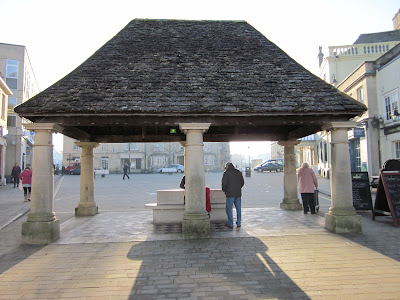
When we moved to Chippenham in 1988, the Buttercross was not in its current home, but a few miles away in the village of Castle Combe . Its rediscovery led to a campaign to bring it back to form a focal point in the market square. Here's what's written about it on the stone bench beneath: The Chippenham Buttercross was built c. 1570 in the position where Barclays Bank now stands today. The centre of the "Butchers Shambles" it was used for the sale of meat and dairy produce. In 1889 it was sold for £6 to Mr. E. C. Lowndes, who erected it as a gazebo in the kitchen garden of the Manor House Castle Combe. The design of the building in its new setting was by NWDC [the then local District Council] architects Jack Konynenburg and Teresa Surawy. The Chippenham Buttercross was re-erected in this position in 1995 by Chippenham Civic Society, paid for by donations... ...there then follows a long list of everyone who donated to the cause. The building you can just see (with 2 ...

Is 'Solar Farming' the Way Forward?

Image
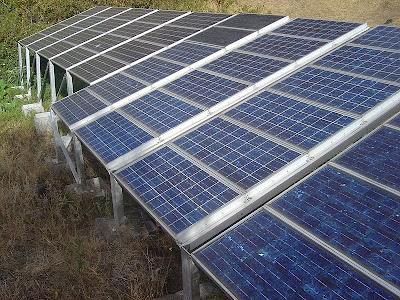
Sometimes a local issue comes along which serves to make my brain hurt very badly as it raises so many others and I simply don't have the answers. The news last week that a Chippenham farmer nearby is proposing to convert 35 acres of his land to solar panels falls firmly into this category. That's 'solar farming' on the scale of around 15,000 moveable panels, each the size of a door and arranged in rows in a field(s) to maximise their capture of the sun's energy. There was quite a lot of talk about it on Saturday at our local resident's association quiz evening which NAH and I attended*. We're now expecting a 'call for action' email any day now and naturally the main point of concern raised so far is what this means from an aesthetics viewpoint. That's the least of my concerns and I'm having a major tussle with myself over whether this is a good thing or not. My greener living head says it is because it means we're making more use o...

Book Review: Organic Vegetable and Fruit Growing and Preserving

Image
As you can see it's a rather long title to fit into the one for my post! Organic Vegetable and Fruit Growing and Preserving Month by Month is probably the longest title of any book in my collection and hints at its comprehensiveness. The authors' pedigree is faultless: they were at Garden Organic (HDRA in their day) for many years and with a science background to boot they're very well placed to write this volume. The title doesn't quite tell you everything this book contains. There's herbs and nutritional information too: the latter is the first time I've seen the subject tackled in the context of growing your own. The book is divided into four main parts. It starts with a brief chapter on the basics which is divided into gardening and nutrition sections. Then follows a detailed month by month guide (grouped by season and starting with winter) of the key tasks. At the end of each season there's a 'project' section of major tasks which are app...

Urban Fox

Image
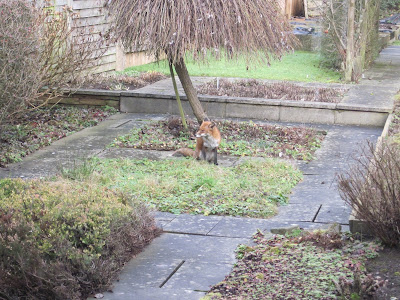
On Monday we had to go up to Birmingham to see my mum. This is the sight NAH and I espied out of the kitchen window whilst making lunch. I've known about urban foxes for years, but this was the first really up close and personal daylight sighting of old Reynard (as mum calls him) I've had. Even NAH was excited at the time and we were able to watch our visitor for a good 5 minutes or so. Back home in Chippenham the urban fox's presence has been in sound only. We often hear them barking at night at the moment as it's mating time. It can quite unsettling until you realise what's actually going on. I wonder whether we might have the return of Skimble the Bold sometime soon? When I lived at home mumble mumble years ago, we found evidence of foxes in the garden, but had no actual sightings back then. A fascinating documentary was shown on the TV around this time highlighting the research carried out by Bristol University which showed just how well the fox has adapted ...

ABC of Chippenham: Avon

Image
Today dawned frosty, misty and sunny: a perfect time to go downtown and take pictures of the River Avon. It's one of several rivers in England with the name Avon : This one is called the Bristol Avon because there's actually two River Avons in Wiltshire. The other is in the south of the county - we're in the north - and is called the Hampshire Avon. Our River Avon arises near Old Sodbury in Gloucestershire and finally drains into the Severn Estuary at Avonmouth, near Bristol. It flows south from Gloucestershire into Wiltshire, where it joins with the Tetbury Avon at Malmesbury, not far north of Chippenham. It then meanders around in a generally westwards direction forming the lifeblood of many Wiltshire towns and villages such as Lacock , Melksham and Bradford-on-Avon - in addition to Chippenham - before flowing into Somerset, and the city of Bath. If you take the train from Bath to the south coast, the line follows the Avon valley for many miles and is one of t...

Wassail! *

Image
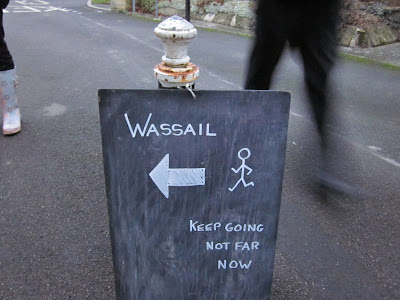
Wassail! wassail! all over the town, Our toast it is white and our ale it is brown; Our bowl it is made of the white maple tree; With the wassailing bowl, we'll drink to thee. Gloucester Wassail - believed to date back to the middle ages and also sung at traditional wassailing times in North Wiltshire. Tonight is the old Twelfth Night**, one of the traditional times to hold a wassailing ceremony. Wassails are sung from around Christmas time until today's date and are centuries old. The purpose of a wassailing ceremony - apart from a good excuse to cheer up the winter blues - is to awaken the apple trees from their slumbers, give thanks for the apple harvest and to drive away evil spirits to ensure the next is a good one. Our choirmaster is very keen on wassail songs, which we've always sung as a 'Happy New Year' welcome to the January term, but Saturday was the first time we'd been invited to perform at a proper Wassailing ceremony. This was held at...

Digging for Victory: Book Review

Image
Digging for Victory by Twigs Way and Mike Brown is a fascinating blend of gardening, history and social history. It tells the story of the government's WWII Dig for Victory campaign, richly illustrated by the stories of the people (or their offspring) who took up the call to grow more food, together with examples from the masses of ministry advisory leaflets, advertisements and articles from gardening magazines and books published at the time. I've written before about my concerns about how we might grow our own food in the future and pondered whether a similar campaign might be successful today. So it's been fantastic to have a review copy of this book to give me a better insight into the harsh reality of the 1940s. The campaign was judged to be a success, but Digging for Victory shows it wasn't without hardship along the way. The story is told more or less in chronological order with varied side trips taken to view the role of the media, the changing role o...