- The return of Mr & Mrs Robin to my shed - they've moved from above the door this year to take up residence on the shelf next to the Blood, Fish and Bone
- The pictured notice on the allotment gate
- Enough red veined sorrel on my neglected plot to make delicious soup
- A green woodpecker a mere two feet away when I got to the allotment yesterday - I'm hoping it'll help to tackle the ants on my plot
- Threadspider's help in kick-starting this year's digging - my patch is starting to look cared for instead of abandoned. Thanks so much my friend :D
Musing on gardening and life in the heart of rural Wiltshire. Well, erm Chippenham actually...
Tuesday, 31 March 2009
5 Things to Warm The Cockles of This Allotmenteer's Heart
Monday, 30 March 2009
Temptation

Sunday, 29 March 2009
There, That's Better
I hope you like the new look: I'd been thinking the old one might not be too good for people with red/green colour blindness anyway and so changing colours was on my blog to-do list. Yesterday's problem meant it just happened a little quicker :)
Many thanks to those of you who left supportive comments, helpful ideas and links to useful stuff over the past couple of days.
Vegetable Matters
.jpg)
I promise a full return to vegetable related matters as soon as possible.
Saturday, 28 March 2009
Blog Layout
I will try again on my return this evening. In the meantime, if you see anything other than the Photobucket bandwidth problem, or if the blog looks fine for you, or indeed if you have any ideas on how I can fix the problem, do leave me a Comment. Thanks.
I've pulled today's scheduled post - whilst the posting part of the template isn't affected, I'm sure you don't really want to view an untidy looking blog!
Update: As I suspected the message is to do with the Photobucket URLs I'm linking to which give me a 3-column template in Blogger. These are held on someone else's Photobucket account, so unless they upgrade their account or let me have the code they hold there, I won't be able to continue to use this template. I suspect neither of these will be happening, in the short term at least.
I think I have 3 other options at this point:
- Revert to a Blogger hosted 2 column template - they don't have any 3 column ones :(
- Find another 3-column template for Blogger - preferably one I can host myself
- Convert to WordPress and use one of their 3 column themes
Ideally I would like to take option 2, but I suspect it's going to take some time to find a suitably reliable template, so in the short term I'll be going back to a 2 column one :(
I've tried option 3 already and have decided WordPress isn't for me unless I also change my link-rich and widget based approach to blogging. I would prefer not to do that at this stage. There's also a longer term option 4 - to have my own website - but I don't think my HTML abilities are good enough to pursue this one at the moment.
Please bear with me whilst I make the necessary changes - normal service will be resumed as soon as possible. Any thoughts/help you have on all of this are welcome!
Update 2 (17:00 pm GMT): So, there I am checking out Happy Mouffetard's superb Out on the Streets post and how it's linking to my blog when I spot the problem's sorted itself out. It looks like the template's image providers have put another shilling in the meter over at Photobucket. In the meantime, I've been up to my eyes in HTML and I now understand a hell of a lot more about how Blogger templates work. You were saved from me putting this new found knowledge into practice in the nick of time. Probably just as well ;)
Many thanks for your supportive comments and suggestions today - especially Linda over at Crafty Gardener - whose link in the comments is to a website which has the best explanation of all of this kind of stuff I've seen so far.
Normal bloggage will resume tomorrow. In the meantime I'm in need of a quick lie-down followed by a curry with my mates.
Update 3: (9:15 am Sunday) Lord, it's back to being weird again - sorry folks. And yes, I thoroughly enjoyed my curry thank you :) Unfortunately I've chosen to amend a template with images in it, and it's these that are hosted on Photobucket. I have two choices - either chose another simpler Blogger template where the amendment to 3-column is pretty straightforward, or stick with this one, obtain the images for myself and set up an account to host them online for me. Either choice is going to take a while to set up and test before unleashing it to you all (and I also need to have a think about the pros, cons and risks of them), so please bear with me as all this has coincided with a particularly busy time. I'll be resuming my scheduled posts later on today as luckily the main part of the blog is unaffected by all of this.
Friday, 27 March 2009
Spring: A Most Dangerous Time

My hearty congratulations to you all. It's spring and your gardens are looking fresh and lovely: there's lots of colour - especially yellow - plus lots of fluffy, fuzzy green is peeping above the soil and on all those branches. You've done a great job the past few weeks - you've tidied everything up, pruned and weeded where needed and now your plants are luxuriating under their new layers of mulch, compost and poultry poo.
What's that..., you think things are looking a bit gappy? I urge caution dear reader. You may have overwintered enough plants to stock a small nursery; you may think it's time to give your garden a bit of a revamp; you may find lots of plants crying out Buy me! at your local garden centre, specialist nursery or plant sale. But remember, you are at your weakest point. You've spent all winter looking at catalogues, dreaming of your ideal garden and how different things will be this year. Your resistance is at its lowest ebb. You've not bought a plant in months, except maybe in seed form, so your purse is crying out to be opened and that desirable little something you've espied bought home to grace your garden.
This is where you must take a deep breath and be strong. Think: Is that really a gap I see over there? Look back at last year's photographs - it could be where your Dahlias will poke their noses through their duvet, or where that tiniest little bit of green you see at the moment plumps up to fill that space entirely. Yes I know you've got lots of pots positively demanding to be planted out. First you must think a little more creatively: is there somewhere in your garden which isn't planted at the moment? Yes, I knew it - that gravel in the side garden is positively crying out for those delicious Iris reticulata you bought at the RHS Show (thanks for the idea James). What really could be replaced? Well, those dead plants you've been nurturing in those pots over there for a couple of years can be whipped out and that nice tree fern plus the 'Congratulations' rose C from choir gave you put in their place.
Consult your photographs again. Is there something that isn't working in your garden - the Forsythia in the corner perhaps? Again be strong and don't get too sentimental: if it wasn't working then, it's unlikely to do so this year. Take it out immediately, before you've got time to think about it: it'll be far more valuable to you as compost or shredded into mulch. Have a look at your nursery area and the plants surrounding the one you've just removed. Select something to complement what's there perfectly - mmm, the Syringa meyeri 'Palibin' that Threadspider gave you last year would look good - and plant it with love and care. If you don't have anything suitable, only then should you contemplate the selection awaiting you elsewhere.
My friends, heed my advice whilst there's still time. Otherwise you'll find yourself with nearly 60 pots of plants you've gathered over a couple of years or so needing a home - just like I have. Spring really is a most dangerous time of the year - especially if you're a plantaholic gardener like me ;)
Love n stuff,
Your very own VP
Thursday, 26 March 2009
Una Gran Sorpresa


I haven't been back to the project since 2000 (I went 2-3 times a year from 1994) as one of the aims of my study was to ensure someone continued with it locally, instead of me waltzing in from England from time to time. On going through the pages of the book, I realised how big a place s'Albufera still has in my heart. As well as sumptuous photographs of the Parc and its wildlife, there's plenty of the staff too - such as Biel, Pilar, Pere, Margalida and Xisco - thus it makes me feel like I've found an old treasured family album in the attic rather than receiving a book. This feeling was enhanced when I opened the accompanying letter from Biel: it began - Apreciada (= valued, fond) - English is often considered to be the richest of languages, but there's nothing like Spanish for setting the tone of a whole letter by the choice of the opening word. I'm so touched by this gesture.
Now I need to press my half forgotten Spanish into service to write a suitable thank you - and I want to book a flight to revisit one of my favourite places in the whole wide world. I also need to find a way of converting my slides into digital format, so I can show you more of this wonderful area.
Wednesday, 25 March 2009
ABC Wednesday 4/VPGGB: J is For...
Tuesday, 24 March 2009
The Kind of AGM Invitation I Like

12-2pm - Bring and Share Lunch and Registration
In addition, younger shareholders who aren't interested in the AGM (though their parents might be) will have their own activities such as bug hunts and arts n' crafts.
If only all AGMs could be so imaginative! The Fordhall Farm story is an amazing one. It's about a young daughter and son's fight to keep their father's farm despite development pressures to evict them. Not only that, their father's approach to organic farming inspired the founding of the Soil Association. I was so moved by their story I decided not only to make a donation, but to become one of many thousands of shareholders who've ensured the future of the farm. It's a fantastic community initiative that I'm proud to be part of and you can find out more about it here.
Monday, 23 March 2009
YAWA/OOTS: Verges

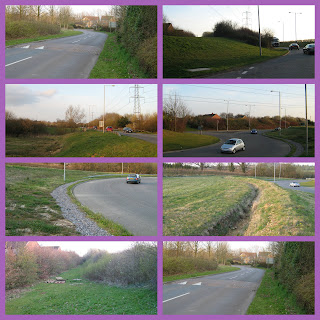
Click to enlarge image if needed. Clockwise from top left: 1. Estate entrance (also bottom, right picture) 2. Bund side view 3. A view of both sides of the road looking south 4. Ditch 5. As 1 6. Behind the bund 7. Gravel soakaway strip 8. A view of both sides of the road looking north
When I first introduced this year's series on public planting, I was unsure whether verges should be included. I had 2 main responses at the time - yes, include them and what's a verge? I promised the You Ask, We Answer team would get on the case, so here at last is their preliminary guide to verges, aka shoulder if you hail from across the pond.
Most verges in the UK refer to a narrow strip of grass at the roadside, just like the edge you can see in the first and last picture in the collage. On more major roads, the design gets a little more complicated and I've chosen one such example to show you - the one closest to my house - on the A350 Chippenham bypass, a mere 5 minute walk away from VP Gardens.
As the busy road borders a housing estate, this side of it has been raised in the form of a bund as Lucy has also shown in her post on Poundbury, plus the joint one we did together. Like Lucy's example, this bund has also had shrubs and trees planted on it - this one is a more mature example as it is 10 years older. Dogwood and native trees are the main mix here in Chippenham. The bund and the trees act as a sound screen to mask most of the road noise from the houses nearby. On the other side of the road is open countryside, so the bund and trees aren't needed and here most of the old hedgerows have been retained as much as possible. Further down the bypass this side of the road is flatter and marks a clearer transition from urbanised to countryside areas.
Susan over at The Bicycle Garden also asked if our verges have ditches. In my example the answer is yes, though they're not there in a lot of cases. Ditches are usually only present when drainage is needed, though in my example it's for a different reason - some travellers camped on this verge* a few years ago, so the layout was changed to discourage them in the future. Lumps of stone and a raised bank were added next to the road and the ditch excavated behind the bank. This in turn led to drainage problems (as my feet can vouch for from yesterday!), so a gravel soakaway was added right next to the road side.
As we build more and more roads in the UK, verges are becoming an increasingly larger proportion of our unused land. Therefore they have an increasing value as wildlife corridors and refuges for our native flora. For new roads, sowing wildflower meadow mixes and subsequent management are often specified as part of the design brief for the highway contractor. Of course many of our verges are a lot older and in 1970 here in Wiltshire, the local Wildlife Trust surveyed most of the county's verges to identify those of particular floral value e.g. there is a verge near Chippenham that has a nationally rare type of mustard; many others are rich in orchids. This has resulted in specific plans being drawn up for the civil engineering company who maintains the highways on behalf of the county council to ensure these 50-odd verges are managed in a sensitive manner. In addition, the trust has a monitoring scheme where volunteers, such as my friend L from choir, 'adopt' a specific verge and complete a questionnaire about its health each year. If the monitors find the verge's quality has deteriorated, then the Trust can work with the county council to ensure the habitat and right management is restored.
As I mentioned at the start of this post, this is just a quick guide to verges here in the UK. In researching it I've found a lot more questions that need answering e.g. who exactly has responsibility for which verges and how they are managed. Therefore, I may return to this topic at a later date. I have sneaked in a tiny preview of part of the roundabout that started getting me so interested in public planting though - see picture 3 - so I will be returning there shortly!
* This verge is much wider than usual, hence it was roomy enough for travellers to camp there. NAH and I believe it's so wide in case the county council decide to make the road a dual carriageway in the future.
This is also an Out on the Streets (OOTS) post as well as a YAWA guide. There's more OOTS posts here - do have a look, or better still there's still time to add your public planting post's URL to the OOTS Mr Linky this month.
Sunday, 22 March 2009
You Know It's Spring When...
- The weather forecast says it's going to snow
- The birds have turned up the volume (see yesterday's post)
- The earth has a rich, damp growy smell
- You're already behind with your gardening jobs
- You've got a million seedlings to prick out and not enough pots/ compost/ labels (select which apply in your case)
- The roar of lawnmowers can be heard in every garden in the street (not us - we have a push/pull one)
- Your carefully nurtured plants aren't growing, but the weeds are
- You have no more space for any more seed trays anywhere, but you've still got at least 50% of your seeds left to sow
- The car park's full at the local garden centre - even on weekdays
- You bump into your neighbours for the first time in months
- Your cat starts chasing butterflies - for Jess it's bright yellow Brimstones
- The birds are pecking out the moss in your lawn
- You find your first slug/vine weevil grubs/aphids/add pest of your own choice
- You also see your first bumble bee/ frog/ ladybird/ lacewing/add beneficial garden friend of your own choice
- Your winter pansies are now flowering after months of looking miserable
- You realise you can't nag NAH to ask the neighbours to trim their conifer hedge for a few months now because there's at least 10 birds nesting in it
- Frank's Plants has started their spring plant sales stint (Kings Lodge School this weekend, Frogwell School next and so on...)
- You can stay out in the garden until teatime (aka dinner, supper, evening meal, whatever)
- You've mislaid at least one vital piece of equipment during the winter and you need it right now
- Plants start reappearing in your garden and you've no idea what they are
- What else can you add to the list?
Saturday, 21 March 2009
Just Listen
This week at dusk I've been entranced by an hour long concert from a song thrush. It's decided to sing in the ash tree on the public land closest to the house, a mere 15 feet or so away. There's such variety in its call, so I've been compelled to open the windows wide and just listen. As the light fades, I'm also aware of the rich smell of earth in the garden - it's as if the ground is opening up to greet the Spring.
The song thrush concert fades at about 7pm just in time for a female tawny owl to start calling for a mate. She patrols up and down the stream that runs past the side of the house, but as yet I've not heard an answering call. As she glides silently into the night, it's the turn of the robins to restart their daytime singing. They often do this in urbanised areas, possibly because of the street lighting. One sits atop a street light not far from where the thrush has been singing, calling out his territory in liquid notes. When he pauses, there's an answering call a little further down the street. And so it goes on until well past bedtime.
If you open your windows wide at eventide at this time of the year and just listen, what can you hear? BTW the links in this post take you to the RSPB entries for each bird where you too can just listen to a smidgen of my magical evening concert.
Friday, 20 March 2009
GBDW - Wild About My Garden

Slow gardening also means leaving most of the faded summer blooms in situ over winter rather than cutting them down, thus leaving lots of seeds for the smaller birds to feed on and many insect larvae hunker down for winter in the stems too. This has an added bonus since we've had the problem of squirrels nesting in the loft (remember - one person's nice attractive wildlife can be another's garden pest), it means I still have lots to feed the birds which, unlike the birdfeeders I'd been putting out regularly, don't feed the squirrels as well. Thus the squirrels have stopped nesting in the loft this year and I've only needed to use supplementary bird feeders when it's been extremely cold. An extra bonus has been lots more birds foraging in the central part of the garden this winter instead of sticking to the edges.
Shelter is also important - I use the garden prunings which are too thick for shredding to create small log piles which are then tucked away towards the back of the borders - these are attractive to insects such as beetles: most species are beneficial to the garden. The rotting log piles, garden leaves and compost bins in my garden means the microscopic garden populations - the fungi and bacteria - have plenty to thrive on, which in turn helps other invertebrates such as my lovely worms - the best garden helpers of all. The birds are currently taking up residence in the trees in and surrounding the garden, plus the Clematis cirrhosa 'Balearica' (a wren's nest in the latter) in a big way at the moment. My quest for shelter for all kinds of wildlife also means there's a good excuse for friends to give simple, but very welcome home-made birthday gifts such as the pictured ladybird (aka ladybug) and bee haven my friends S & L gave me last week. All you need is a thick slice of tree branch (apple in this instance) drilled with lots of inch deep holes plus two T shaped brackets fixed to the back for attaching it to the fence and you can have one too!
Apart from squirrels and smaller mammals such as mice and voles, I don't have the more 'gardener challenging' wildlife visitors such as foxes, rabbits, deer or badgers. Whilst I love seeing these animals (and most of them have been seen close by), their presence in my garden would be a test for my love of nature. This is currently happening on the allotment, where foraging badgers have taken a liking to crops such as sweetcorn!
Garden Bloggers' Design Workshop is hosted by Gardening Gone Wild.
Thursday, 19 March 2009
Hebe Haircut
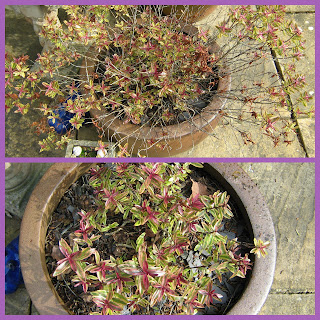
For a few years I've had a couple of potted Hebe 'Bronzy Baby' on either side of the stone bench on the patio. Their domed foliage tends towards yellow in the summer and colours to bronze in the autumn, making a plant of year-round interest and a good foil to my surrounding seasonally planted pots. I've been taking advantage of the warm weather this week to take my coffee breaks outside and as a result I spotted they'd become rather leggy and uninteresting. My first thought was to ditch them so I would have a plant buying opportunity - Franks Plants will be starting its Spring sales soon after all - but on looking a wee bit closer I spotted there was lots of fresh growth coming out of the base of each plant. Snip, snip, snip and hey presto! A couple of haircuts and two fresh new looking plants in ten minutes flat :)Wednesday, 18 March 2009
ABC Wednesday 4: I is for...
... In Bruges on market day
NB If you'd like to look at an image for longer, just hover your mouse over it and the pages will stop turning until you move your mouse again.
On our first day in Bruges we kicked off with a walk to the local market. I loved being merged in with the locals - trying to make out key Flemish phrases, hearing the cries of the hawkers and comparing it with markets back home. There's a lot of similarity, but I liked being able to try lots of fruit before buying and I reckon about half of the veggie space was devoted to Witloof chicory - hardly seen on sale in the UK. I did find some sprouts too. A small livestock section was a surprise and at last there were lots of garden plants on view. Judging by what was on offer, Bruges and its surrounding area must be on an acid soil. Nearly everyone was stopping off at the flower stall to buy an enormous bouquet to brighten their weekend.
Here's a selection of images from the 'living' part of the market, tucked away down one of the side streets and a smaller square. I've spared you the clothing and household sections, though I can't believe I didn't take any photos of the mouthwatering cheese and meat stalls. Perhaps I was concentrating too much on the free samples at this point! And we found the cheapest fresh coffee in town - 1 euro, complete with mini praline Belgian chocolate egg :)
For other Interesting Images for today, head on over to the ABC Wednesday blog.
Tuesday, 17 March 2009
OOTS: If It's Tuesday, This Must Be Belgium *

Most of the pictures are from Bruges, but I have sneaked one in from a quick side trip we did to Ostende in order to be able to use the post title I've been dying to use for ages. We travelled by Eurostar to Brussels and then by Belgian railways to Bruges (travel tip: if you travel by Eurostar your onward rail travel in Belgium is free), so I spent a fair bit of time staring out of the window into a lot of back gardens. Two observations from this time: pollarding is BIG in Belgium as are back gardens of just lawn with an evergreen hedge around them. As you can see pollarding was also big in Bruges (with pleached pollarding by way of variation), as were clipped hedges - mainly box and yew - so it was quite a relief to find beech being used by the concert hall (top left).
As central Bruges is a medieval city, the buildings are huddled up tight together, so there aren't that many gardens to see (public or otherwise) and most of these are very small. The top middle and bottom left pictures are a couple of examples, with hedging and pollarding again featuring strongly. There's also a lot of window boxes - containing mainly box or ivy - so it was refreshing to find somewhere using daffodils instead. One of the boat hire places had lots of bright yellow pansies to brighten up the place. Blocks of single species planting were everywhere, even at the seaside (left side second picture down), where the grass used echoed the colour of the beach.
The least formal planting was to be found on the circular walk I told you about yesterday. Here at last were the mass plantings of bulbs (middle row) I'd been expecting, many trees unleashed from trained forms and lots of hints of other kinds of interesting plants just beginning to push their noses through the soil. Judging by the postcards, the evergreen formal looking window boxes will get replaced later on in the year with something much more colourful. I saw one roundabout - in Bruges by the railway station - middle row, second photo up. It looked a lot like the ones around here, but bigger and with flags.
So certainly in March public planting is very formal and tending towards the evergreen. I also got the impression from the few people I spoke to that not many Belgians are passionate about their gardens. There were some notable exceptions seen from the train, but the next common garden use I saw after lawn+hedge, was back garden veggie growing. I'm sure I'm making some sweeping generalisations in what I saw and our trip to the local market (tomorrow's post) suggests there's more gardening and plant loving going on than I saw whilst I was there.
Don't forget - there's still time to show us what public planting's like Out on the Streets in your neighbourhood (or foreign country if you like) during March. Simply write your post on your blog and go here to add your link.
* = One of my favourite film titles of all time, but not a film recommendation
Monday, 16 March 2009
In Bruges *

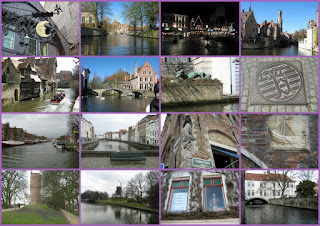
Bruges (or Brugge as the residents prefer) is a beautiful city - postcards don't do it justice, never mind the couple of hundred snaps I took of it whilst we were there. It's the first time ever NAH has arranged a holiday for us, so that also added to my positive view of the place, plus he chose this hotel, so I'm feeling thoroughly spoilt and pampered.
It's a perfectly preserved medieval city - the prosperous times were in the 12th-14th centuries and the residents were so rich, they could afford to build most of their houses in stone. This has helped in its preservation. After that, the city went into relative decline and whilst its 'ownership' changed hands a few times, there wasn't enough importance attached to Bruges to either build it up further or to totally destroy it during various wars. Now the Belgians are fiercely proud of their heritage and we spent a couple of hours in the company of a delightful octogenarian who told us the story of his city. It's a World Heritage site now and was also European city of culture in 2002, so we benefitted from the major sprucing up which has taken place to achieve these awards.
The collage (click to enlarge if needed) gives a small sample of the sights to see - I was equally enamoured of the small details on the buildings as well as the overall architecture of the place - gold highlights, little friezes on the walls giving clues to what the buildings were originally used for, Madonna statuettes presiding over pretty well every street corner, even the drain covers are up market.
Of course every visit to Bruges needs a boat trip round the canals - it should take half an hour, but our guide spent over an hour with us pointing out tiny little features and details. We also took the circular walk around the outside edge of the Medieval part of the city - hence the views of more workmanlike barges, windmills and one of the city gates (bottom left). We also found time to sample all the things Belgium is famous for - chips, chocolate, waffles and beer!
I'll be returning to Bruges tomorrow - on a more plant related theme this time.
* = I think this film may have influenced NAH's choice of where to whisk me off to.
PS I also fell in love with St Pancras Station - there's a slideshow here if you're interested.
Sunday, 15 March 2009
GBBD - Bring on the Dancing Daffodils!

I was very tempted to leave you with everything awash in yellow, but I couldn't resist another shot of my very ordinary purple crocuses and the absolutely gorgeously perfumed geisha pink of Prunus mume 'Beni chidori' seen in the two pictures at the top left (click to enlarge the collage if needed). A few Anemone blanda (top right) have also pushed their noses through the soil and the Pulmonaria has recovered magnificently from the snow (bottom right) to contrast nicely with my late flowering 'February Gold'. Kerria japonica 'Flore Pleno' (top right, to the left of the Anemones) is poised to add to the riot of yellow out the front and you can also see the primroses and Clematis cirrhosa 'Freckles' (now also with 'Balearica' mixed in on the left) are still giving good value, even when the 'Freckles' flowers lower down the wall have turned into delightful fluffy seedhead balls.
Flowers not making the cut for display this time are Viburnums - tinus 'Eve Price' and x bodnantense 'Dawn', Skimmia, Lonicera purpusii 'Winter Beauty', Violas, the first few tulips, yellow crocuses, budding grape hyacinths and the last of the snowdrops. Talking of which, I've carried on with my annual snowdrop count this year. The final tally (with last year's numbers shown in brackets) taken on March 1st was:
Back Garden - 308 (195)
But now, my thoughts are firmly turned towards the miracle of spring and everything the garden and allotment are calling me to do. So whilst I get on with that, I'll show you a few of my holiday snaps over the next few days - don't worry, most of them do have something to do with gardening ;)
Garden Bloggers' Blooms Day is hosted by Carol over at May Dreams Gardens.
Saturday, 14 March 2009
Collaborative Book Project: Your Votes Count
Our thoughts have also turned to the all important, make or break name for the book. We've brainstormed all sorts of ideas and need your help once more in deciding which one is the best. We're aiming to sum up in one catchy title that whilst the book's about kitchen gardening, it's also by bloggers, so it's going to be very different to the usual 'how to' kind of manual. We'd like you to vote for the title which you think sums this up in the best way and would make you want to read the book. Miss Fuggles has set up a poll for you to add your votes - don't worry if more than one title takes your fancy - you can vote for as many as you like. The important thing is to take this link and vote now as the poll closes tomorrow!
Friday, 13 March 2009
Red Nose Day - Gardening Jokes Anyone?

This year's different - every day's a dress down day for me now - my friend L suggested yesterday that perhaps I could have a dress up day instead and whilst that's a good idea, I confess that ballgowns and tiaras don't really feature in my wardrobe: scruffy student's always been my favourite look.
So my Red Nose Day contribution for this year is to compile a list of gardening related jokes. For each one (clean ones only please) you leave in the comments below, I'll make a donation of 50p to the cause. Here's a few for starters just to get you warmed up:
Q Why do potatoes make good detectives?
Q What did the grape say when it got trodden on?
Q What do you get if you cross a four leaf clover with poison ivy?
So that's £1.50 so far - can you do better? I think so!
Thursday, 12 March 2009
Out on the Streets: A Blogging Miscellany
Anna spotted this stylish planting complete with edible kale and chard whilst in FranceNoel Kingsbury introduces his latest project for Bristol City Council; whilst Adam Woodruff writes about his vibrant design for the Bank of Springfield in Illinois on his own website and over at Gardening Gone Wild, where Frannie Sorin also told us about the vertical garden she found in Israel. Meanwhile Claire Potter shows us some tres chic French style from her travels.
Grow This questions the wisdom of shopping mall schemes in his neighbourhood; Julia bemoans the changes in London's St. James' Park, finds a good municipal planting for winter interest and has a look inside West Middlesex Hospital.
Catmint's been mulling over the use of native species for her garden and has changed the design of the nature strip outside her Melbourne home as a result. Alternatively, Otter Farm Blog thinks we should be thinking about edible public areas.
And finally Garden Wise Guy introduces the winners of the 2nd Santa Barbara Not So Beautiful Awards.
If you'd like to join in March's Out on the Streets look at public planting - all you need to do is write your post and add your details to Mr Linky in here.
Wednesday, 11 March 2009
ABC Wednesday - H is for...

Friday, 6 March 2009
Veg Plotting is Away
.jpg)
Whilst I'm away, how about telling me about your favourite sign of spring in the comments below. Is it the crocus like those in my picture? Perhaps it's daffodils, snowdrops, intense birdsong, swelling buds, catkins - or something else?
Thursday, 5 March 2009
Out on the Streets: Poundbury Bypass

Poundbury is an area of new housing and places to work on the outskirts of Dorchester.
Emotionally and geographically, it looms on the county town's horizon. Not everyone likes it. Its mixture of styles is seen as a mish-mash rather than eclectic, and its emphasis on the traditional and the vernacular - a snub to contemporary architects.
(I like it!)
But, whatever people make of Poundbury, one thing is certain. Much thought and effort has been put into it, with a lot of attention to detail.

The bund which runs along the bypass (on the A35) is an example of this. It is a huge earthworks, a rampart against the noise of traffic. It is also described as a 'Nature Break' because more than a thousand English native shrubs and trees have been planted along its bank to provide a future habitat for small animals and birds. The trees are ones which will be short in stature when fully grown and include dogwood, blackthorn, small ash and holly.
Most gardens in Poundbury are tiny. However, even they provide a haven for small birds and there are more living in them now than there were in the fields and hedgerows of the immediate area before building began. Even the houses have been built with birds in mind for they have eaves for swallows to nest in.
What with its mixture of housing association and privately owned dwellings, its imaginative playgrounds for small children, the determination to have places of work right where people live instead of hived off onto industrial estates, it would be nice to say this is a vision of socialism, designed by the people, for the people. But . . . well . . . no . . . it is all on Duchy of Cornwall land - which means it's the brain child of Prince Charles.
(Incidentally, washing lines are allowed. "That they are not is a myth," I was told when I phoned the Duchy Office to check. "There are lots of myths about Poundbury," said the man on the phone, with a sigh.)
Thanks Lucy - that's great stuff. Her photos show one of the common solutions for our bypasses around built-up areas. As well as the trees providing a stabilisation of the steep slope and a screen against traffic noise, grants are available for the planting. My concern is their density and whether any thinning out is included in the plans for these schemes. I also wonder if any wildflower sowing is planned for lower down the slope as a number authorities have incorporated this into their roadside plantings. More on this when I post my guide to verges later. We may yet hear some more from Lucy on this topic as she emailed me a couple of days ago:
Someone from the Duchy office phoned during the day - not realising someone else had already replied to my questions. So I asked him about planting density and why there are trees only on one side of the bund. He seemed quite startled about the second question - it hadn't struck him before - so he's going to find out the answers to both and phone back.
Remember, there's still time for you to tell us about the public planting in your neighbourhood. All you need to do is write a post on your blog sometime in March, then go here and add your name and URL of your post to the Mr Linky widget at the end, so that everyone can find you. I'll also be writing a wrap-up at the end of the month as well as adding a couple of extra pieces of my own in the meantime.
Wednesday, 4 March 2009
ABC Wednesday 4 - G is For...

I'm feeling a little like I'm following in the footsteps of Darwin again at the moment as I'm using my garden as a laboratory AND studying earthworms. I'm taking part in OPAL's Soil and Earthworm Survey: this is an initiative set up to celebrate biodiversity and people's partnership with nature, something that's right up my street.
They're planning a number of scientific surveys in which schools and the general public in the UK can take part. The first of these is earthworms and my study pack arrived a couple of weeks ago. I have booklet detailing what I have to do, an earthworm identification key (put together by those lovely people at the Field Studies Council), a magnifying glass and some basic soil testing equipment. I'm surveying both my garden and allotment: I'm particularly concerned that my garden's earthworm population might be a little on the low side as I rarely see them when I'm digging.
As well as digging a little pit to test my soil and look for worms, I also need to survey any other microhabitats within 5 metres of my chosen patch. Here you can see some of the many earthworms which occupy my compost heap. Most of them are juveniles (as the survey expects), but those which are large enough to use the key further, come out as compost worms (Eisenia veneta) or brandling worms (Eisenia fetida), both of which are usually found in compost heaps. Now all I have to do is to keep them still, so I can measure them!
The survey is on from now until May and you can still take part. They aren't sending out any more packs like mine, but the link takes you to where you can download the survey pack and earthworm identification guide. All you need to add are a couple of packs of mustard and vinegar, a couple of pH testing strips, plus a plastic ruler and you're fully kitted out to take part! I'll be uploading my results onto the website very soon and seeing how they compare with others in my area and nationwide. Scientists at Imperial College and the Natural History Museum are also very interested in seeing the results.
The OPAL website is well laid out and packed with information - well worth a look. I see they're also concerned about bee populations at the moment: something that should be of concern not just to gardeners, but to us all because of their vital role in food production. I've just clicked through OPAL's link to the Save Our Bees website which is launching a bee survey to coincide with the start of National Science Week on Saturday.
News hot off the press!!! The RHS seed trial this year is mange tout and sugar snap peas - yum. If you'd like to take part, you need to look pretty sharpish and go here. The first 200 to sign up will be given their seeds by Thompson & Morgan. I was too late for the free seeds for last year's radish trial, but I joined in anyway.
Click here for other Glorious ABC Wednesday contributions.
Tuesday, 3 March 2009
Fairtrade - Chippenham Update

Most of the directory's 16 pages is geared towards explaining what it's all about. Places in Chippenham listed as selling Fairtrade goods forms less than a double page spread and that includes outlets in some of our nearby villages. Just looking at the town's cafes, only half of them have Fairtrade options on offer like tea and coffee. I also did a quick recce round my supermarket at the weekend and could see no increase in Fairtrade goods for sale compared to last year. No wonder my shopping habits haven't changed that much, but at least now I have a handy form listing the variety of Fairtrade products available, which I can hand in to my local store to request what I'd like to see there.
Some progress then, but lots more is needed - the target date set to achieve Fairtrade status for Chippenham is by the end of this year.
Monday, 2 March 2009
Out on the Streets: Temple Quay, Bristol

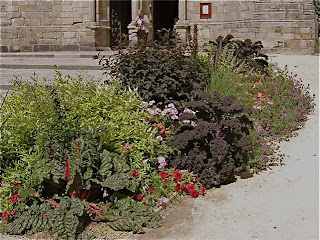
This is a place I went past nearly every day for 8 years as it's right by where I used to work in the centre of Bristol: in fact the office in the background of the top left photograph is the very building. At first glance, this example has the features I would usually say are what's so bad about our public planting: there's not many cultivars and most of it's just plain green and will stay that way. However, when I looked at it afresh last October, I believe whoever designed this has been quite clever. I'll tell you why and let's see what you think. You can click on the image to enlarge it if you'd like a closer look.
To add some height, easy care Mahonia x media 'Charity' has been chosen - see the back of the planting in the top right photograph. I'm used to seeing a fine leaved shrubby hedge of Lonicera nitida or Cotoneaster horizontalis instead, so top marks for choosing something different this time. I don't usually go for Mahonia myself, but here they'll be providing winter scent and colour in addition to clearly marking the boundary between the office building and the main part of the street.
To highlight the planting, a wispy grass (don't ask me which one - I'm only just beginning to appreciate them) has been used to add a little extra height and movement. It's also marking the boundary between the Hebes and the sculpture. That's also unusual: the inclusion of a sculpture - a tick of approval from me.
A curved row of trees has been planted close to and echoing the line of the street boundary. Again I don't know which one's been chosen, but I like that a pyramid shape's been chosen instead of a lollipop (which I'd be tempted to do to echo the shape of the Hebes, but now feels wrong after seeing this) and the bark adds some further interest too. The photos were taken at the end of October, so you can see that the leaves stay on the tree for a long season. As they grow and mature, they'll help to screen out the main road and offices on the other side.
Finally, the planting is sited in a modern office block area - the buildings date back no further than 2000, so the design as a whole has a contemporary feel to it but contrasts nicely with the steel and lighter coloured stone and concrete of its surroundings.
So there you have it - just 3 plants, 1 type of tree and a lot of green. Sounds boring when put like that doesn't it? Having seen the photos, what do you think?
This forms my first entry for this quarter's Out on the Streets. I'll probably add some further ones this month e.g. a YAWA guide to verges. Lucy and I have a joint post planned too. If you're wondering what Out on the Streets is about, last week's kick-off post serves as an introduction and a source of ideas. There's just a couple of points from the comments on there I'd like to clarify here:
Love the idea, but I've got nothing to show you for March. That's fine - I look forward to seeing you in June. However, if the place you want to feature isn't ready yet, that doesn't matter. It could be just as interesting to show it to us in that state now, or to include as a contrast shot later if you prefer.
I've already posted something recently that fits into this topic. That's great! Just add your name and the URL of your post (not your blog) to Mr Linky below and we'll come and visit. You'll see I've already added your Florida post Mr McGregor's Daughter as I'd bookmarked it at the time: do please add the URLs of your good/bad planting posts too :)
So, whenever you're ready to post, don't forget to come back here and add it to Mr Linky. I've put an Out on the Streets link at the top of my right hand sidebar which will stay there until the end of March for this quarter's posts. Just click on the photo and it'll get you here so you can do the necessary. If you're not posting this time around, I'll set up another Out on the Streets kick-off post at the beginning of June.
Sunday, 1 March 2009
GBMD - The Lent Lily

And there's the windflower chilly
And since till girls go maying
Bring baskets now, and sally
A.E. Housman - A Shropshire Lad (1896). NB Housman was born 150 years ago this month.
The daffodils are much later this year: these Tete a Tete popped open only a couple of days ago in my front garden and the ones in the back are all steadfastly in bud, even Jetfire which is usually the first to bloom. Last year, they first opened on February 7th, so all that frost and snow over the past few months has knocked back their first flowering by 19 days. I also wrote about daffodils this time last year and yesterday's post tells you where you can go to see them in the wild this month, including the place in the Lake District which inspired Wordsworth to write his most famous poem: Daffodils.
Garden Bloggers' Muse Day is hosted by Carolyn Gail at Sweet Home and Garden Chicago.
.jpg)